You started levothyroxine six weeks ago. Your brain fog is better, but you still feel tired. Your doctor just called with lab results: “Your TSH is still a bit high. We’re increasing your dose by 25 micrograms.” You hang up thinking, Why doesn’t my dose feel right yet? Why another wait?
Here’s the truth: dose adjustment isn’t a switch—it’s a calibration. Your body and your medication need time to find equilibrium, and your TSH levels are the map that guides the journey.
In this guide, you’ll learn:
– Why adjustments take 4–6 weeks (and why that timing matters)
– How doctors read TSH to know when to change your dose
– What your TSH number actually means for you
– Real troubleshooting scenarios when adjustments stall
– When to trust the process and when to advocate for faster changes
Most people find their optimal dose within 3–6 months. Let’s decode the adjustment timeline so you understand why it feels slow—and why it works.

Dose adjustment usually starts with a lab value that finally explains how the patient feels
The number matters because it turns symptoms, timing, and treatment response into something measurable.
Understanding TSH and Why It’s Monitored
Before dose adjustments make sense, you need to understand TSH: the hormone your body uses to communicate with your thyroid.
TSH stands for thyroid-stimulating hormone. It’s made by your pituitary gland (in your brain), and its job is simple: Tell the thyroid how much hormone to produce. When your thyroid hormone levels are low, your pituitary releases more TSH (essentially saying, “Make more!”). When levels are high, your pituitary releases less TSH (saying, “You’re fine, dial back”).
Here’s why doctors monitor TSH instead of just measuring T4 (the active thyroid hormone):
TSH is the feedback signal. It tells your doctor whether your current levothyroxine dose is hitting the sweet spot. If your TSH is elevated, it means your body is asking for more hormone. If your TSH is suppressed (too low), it means you’re taking more than you need.
Normal TSH Ranges (And Why They Vary)
For most adults taking levothyroxine for hypothyroidism, the target TSH range is 0.5–5.0 mIU/L.
But “normal” shifts depending on your situation:
Pregnancy: Target TSH drops to 0.5–3.0 (your thyroid needs to work harder during pregnancy, and hypothyroid women need more replacement hormone to meet pregnancy demands).
Elderly patients: Doctors often accept a slightly higher TSH (1.0–7.0) because aggressive lowering can increase heart risks.
Thyroid cancer surveillance: If you had thyroid cancer and were treated with surgery, you might need TSH suppression—a target as low as 0.1–0.5 to prevent cancer cell stimulation.
Post-thyroidectomy: Patients who had their entire thyroid removed often need TSH on the lower end (0.5–2.0) to feel optimal.
Your doctor knows your situation. The “normal” range on lab results is just a guide; your target range is what matters.
The 4–6 Week Adjustment Cycle: Why Timing Matters
This is the question every patient asks: Why can’t we just keep adjusting until it feels right?
The answer lies in how levothyroxine works in your body.
Half-Life and Steady State
Levothyroxine has a long half-life of about 7 days. That means if you stop taking it, it takes 7 days for your body to lose half of the circulating hormone. It takes 4–6 weeks to reach “steady state”—the point where your blood levels plateau and stabilize.
Here’s why that matters: When you change your dose, it takes 4–6 weeks for your TSH to reflect that change.
If your doctor increases your dose on Monday, your TSH won’t truly reflect that new dose until late April or early May. Testing at week 2 or 3 would give a false low reading because the hormone is still accumulating. Testing at week 8 might miss the adjustment window entirely.
Four to six weeks is the sweet spot. It’s long enough for steady state, short enough to iterate if adjustments are needed.
What Happens in Each 4–6 Week Cycle
Weeks 1–2: The dose enters your system
– You start taking the new dose
– Levothyroxine levels begin to climb (but slowly—remember, the half-life is 7 days)
– You might feel a shift (more energy, less fatigue, or in rare cases, slight jitters from too much)
– But your TSH? Still processing the old dose
Weeks 3–4: Body is adjusting
– Hormone accumulation continues
– Symptoms might fluctuate (this is normal; your body is recalibrating)
– You’re not quite at steady state yet
Weeks 5–6: Steady state reached
– Your blood levels have plateaued
– Your TSH now reflects the new dose
– Lab work at this point gives your doctor accurate data
Real scenario: Sarah increased from 50 mcg to 75 mcg on January 15. By late January, she felt energized—too energized. Slight tremors, racing heart. She worried she’d overdosed. But her TSH lab at week 5 showed she was actually still a bit low on dosing needs. The “jittery” feeling was temporary adjustment; her body settled down by week 7. Her TSH normalized, and by February, she felt perfect.
The patience pays off because adjusting too frequently would create a yo-yo effect: raise the dose, then raise it again before the first raise even took effect, overshooting the target.

Adjustments are usually small but deliberate
Most dose changes are careful, incremental, and tied to follow-up timing rather than dramatic symptom-chasing.
How Dose Adjustments Work
When your TSH labs come back, your doctor has one job: Compare the TSH to your target range, then adjust or hold.
If TSH Is Elevated (Higher Than Target)
Your body is signaling, “We need more hormone.”
Your doctor increases your dose, typically in increments of:
– 12.5 mcg (small, careful increase)
– 25 mcg (standard increase)
Typical levothyroxine doses range from 25 mcg to 200+ mcg, depending on the starting point and your needs.
If TSH Is Low (Below Target)
Your body is getting too much hormone.
Your doctor decreases your dose by 12.5–25 mcg.
If TSH Is In Range
Your doctor says: “You’re good. See you in 6–12 weeks” (or longer if you’re stable).
The Tricky Part: Over-Adjustment
Over-correcting is a real risk. Some patients cycle between TSH that’s too high and too low for months because adjustments are too aggressive.
Consider: A patient starts at 50 mcg with TSH of 8 (too high). Doctor jumps to 100 mcg. Six weeks later, TSH is now 0.2 (too low). They drop back to 75 mcg. Six weeks later, it’s 3.5 (decent, but they’re still searching). A more measured approach—50 → 75 for 6 weeks, then reassess—often lands on the right dose faster.
Common Dose Adjustment Scenarios
Let’s walk through real-world examples so you recognize your own situation.
Scenario 1: Starting From Scratch (Initial Loading Phase)
The situation: You were just diagnosed with hypothyroidism. Your TSH is 18 (very high). Your doctor starts you on 50 mcg.
What to expect:
– Week 1–3: You might feel slightly better, but you’re not “there” yet
– Week 4–6: Lab work shows TSH has dropped (maybe to 8–10). Still elevated, so dose increases to 75 mcg
– Week 10–12: TSH is now 4–5. Much better. Some patients stay here; others increase to 88 or 100 if symptoms suggest they need more
– Month 4–6: Final adjustment to 100–125 mcg. Most patients stop here
Lesson: Starting phase can take 3–6 months because you’re often starting low and titrating upward carefully.
Scenario 2: Slow TSH Response (Dose Adjustment Resistance)
The situation: You’ve been on 100 mcg for 8 weeks. TSH was 6 (high). Doctor increased to 125 mcg. Six weeks later, TSH is still 5.5.
Possible causes:
– Absorption issues: You might not be absorbing the levothyroxine well (celiac disease, IBS, calcium/iron interactions)
– Drug interactions: Another medication is interfering (see our article on interactions)
– Timing problems: You’re taking it with food or supplements that block absorption
– Under-dosing: 125 mcg genuinely isn’t enough for your body (some people need 150+ mcg)
What to do: Don’t just keep increasing. Your doctor might:
1. Ask about your absorption (when you take it, what you eat)
2. Check for interference from other medications
3. Run additional tests (free T4, in addition to TSH)
4. Try a different brand (if you’re on generic, try name-brand Synthroid, or vice versa)
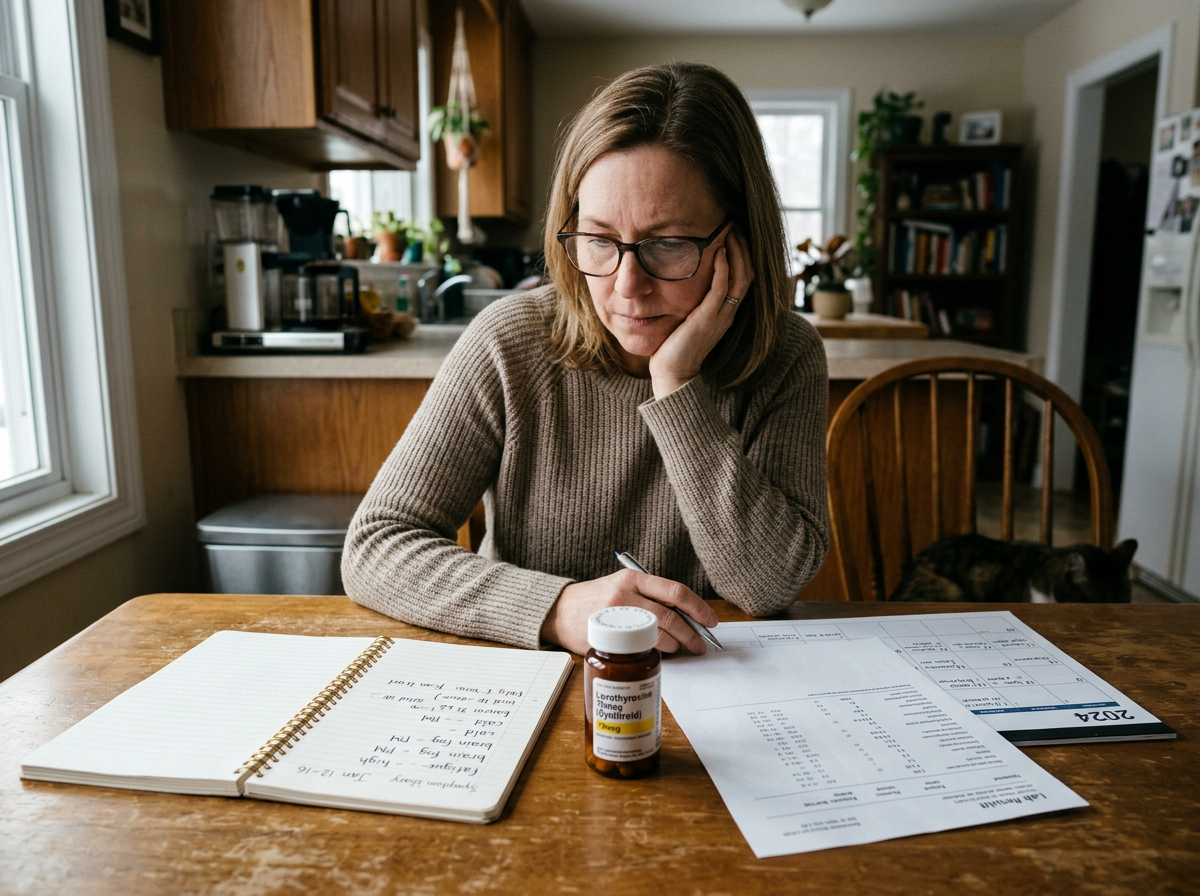
When the labs still miss the target, the routine often holds the answer
Timing mistakes, refill changes, and inconsistent spacing can all make a good adjustment plan look like it failed.
Troubleshooting: When Adjustments Don’t Work As Expected
TSH Plateaus and Won’t Budge
You’ve increased your dose twice. TSH should be dropping, but it’s stuck at 5.5. You feel frustrated.
Root causes:
1. Poor absorption: Celiac disease, Crohn’s disease, IBS, or even chronic diarrhea can prevent levothyroxine from absorbing properly
2. Interaction with supplements: Calcium, iron, magnesium, or high-fiber supplements can bind levothyroxine and reduce absorption
3. Interaction with medications: Omeprazole (acid reflux), some antacids, sertraline (Zoloft), and others can reduce absorption
4. Bioavailability issue: Some generics have absorption differences; switching brands can help
5. Thyroid autoimmunity: If you have Hashimoto’s, thyroid antibodies can fluctuate, affecting your needs
What to investigate:
– Review your medications and supplements with your doctor
– Make sure you’re taking levothyroxine on an empty stomach, 30–60 minutes before food
– Ask your doctor about spacing supplements (e.g., take calcium 4 hours apart from levothyroxine)
– Consider a brand change if you’re on generic
– Get tested for absorption issues (celiac panel, vitamin B12, iron levels)
Symptoms Persist Despite “Normal” TSH
Your TSH is 2.5 (perfect), but you still feel exhausted and brain-fogged. You wonder: Is the TSH wrong?
This is real, and here’s why:
- Optimization vs. correction: “Normal” TSH and feeling optimal are different things. Some people feel best with TSH around 1.0, others at 3.5. There’s individual variation.
- Free T4 matters too: TSH tells part of the story. Your free T4 (the actual active hormone) might be on the low side of normal.
- Conversion issue: Your body might not be converting T4 to T3 (the more active form) efficiently. This is rare but real.
- Other conditions: Hypothyroidism is common, but it’s not the only cause of fatigue and brain fog. Vitamin B12 deficiency, sleep apnea, depression, anemia, and others can coexist.
What to do:
– Ask your doctor to check free T4, not just TSH
– Ask about your specific TSH target (is “normal” optimal for you?)
– Explore whether you’re converting T4 to T3 adequately
– Rule out other causes (B12, iron, sleep quality, depression)
– Consider whether a slight dose increase might help (even if TSH is “normal”)
Special Populations and Adjusted TSH Targets
Your TSH target isn’t one-size-fits-all. Here’s how it shifts:
Pregnancy and Levothyroxine Adjustments
If you’re planning pregnancy or already pregnant, you almost certainly need a higher dose of levothyroxine.
Why? Pregnancy increases your body’s demand for thyroid hormone. Inadequate replacement during pregnancy can harm fetal brain development.
Adjustment: Most doctors increase levothyroxine by 25–30% as soon as pregnancy is confirmed. TSH target drops to 0.5–3.0.
Monitoring: More frequent TSH checks (every 6–8 weeks instead of 12) because needs shift throughout pregnancy.
Postpartum Adjustments
After you deliver, your demand for thyroid hormone drops back to normal. Your levothyroxine dose usually returns to what it was before pregnancy.
If you don’t reduce the dose, you might become over-replaced and develop symptoms of hyperthyroidism (racing heart, tremors, anxiety).
Elderly Patients
Older adults are more sensitive to excess thyroid hormone. Aggressive TSH lowering can increase atrial fibrillation (irregular heartbeat) risk.
Target: TSH often ranges 1.0–7.0 in elderly patients (higher than younger adults).
Caution: Doctors aim for gentle replacement rather than perfect TSH normalization.
Heart Disease or Arrhythmia History
If you have a history of heart problems or irregular heartbeat, your doctor will be conservative with dosing.
Strategy: Start low, increase slowly, target TSH on the higher side of normal (1.0–3.5) to minimize cardiac stress.
Thyroid Cancer and TSH Suppression
If you had thyroid cancer and underwent thyroidectomy and radioiodine treatment, you likely take levothyroxine at a suppressive dose.
Goal: Keep TSH very low (0.1–0.5 or even undetectable <0.01) to prevent any remaining cancer cells from being stimulated by TSH.
What this means: You’re taking more hormone than a typical hypothyroid patient. You might feel slightly “wired” or have a faster heart rate. This is intentional and necessary.

Follow-up testing is what turns an adjustment into a confirmed improvement
The dose change itself is only half the process; the recheck is what tells you whether the new plan actually worked.
Monitoring: How Often and What to Watch
Your TSH labs follow a schedule based on where you are in your treatment journey.
Initial Phase (Finding Your Dose)
- Every 4–6 weeks after starting or adjusting
- This phase typically lasts 3–6 months
- You’re iterating toward your optimal dose
Maintenance Phase (You’re Stable)
- Annual TSH checks (or every 12–18 months)
- Once you’ve found your dose and feel well, less frequent monitoring is fine
- Your doctor might say, “Check back in a year”
When Extra Monitoring Is Needed
- Pregnancy: Every 6–8 weeks (needs change)
- Starting a new medication: Repeat TSH at 6 weeks (some drugs interfere with levothyroxine absorption)
- Symptoms changing: New fatigue, weight gain, palpitations—repeat labs to check if your dose needs adjustment
- Before major procedures: Some doctors recheck TSH beforehand
- Age milestones: Elderly patients sometimes need dose adjustments as metabolism shifts
Tracking Symptoms Between Labs
You don’t have to wait for lab work to notice problems. Keep a simple log:
- Energy level (1–10 scale)
- Weight changes (weekly weigh-in)
- Sleep quality (hours, restful or restless?)
- Mood (stable, anxious, depressed?)
- Physical symptoms (tremors, heart palpitations, cold intolerance, hair loss)
When you see your doctor, bring this log. It helps contextualize lab results and guides the next adjustment.
Special Situations: When Adjustment Speeds Up or Slows
Most dose adjustments happen every 4–6 weeks. But sometimes the timeline changes.
Faster Adjustments (2–3 Weeks)
Your doctor might recheck TSH sooner if:
– You’re severely symptomatic (extreme fatigue, severe constipation)
– You’re in the immediate post-pregnancy period (postpartum phase, dose reduction)
– You’ve had a major dose change (e.g., doubling from 50 to 100 mcg)
Slower Adjustments (8+ Weeks)
Your doctor might space out labs further if:
– Your TSH is in range but you’re still adjusting emotionally to the dose
– You’re older and doctors are being extra cautious
– You’ve been stable for months and they’re confirming long-term stability
When to Ask for Faster Adjustments
If you’re suffering and your doctor wants to wait the full 6 weeks, it’s okay to ask:
“I’m experiencing significant [fatigue/brain fog/insomnia]. Can we recheck TSH at week 4 instead of week 6?”
Most doctors will agree if your symptoms are severe.
Conversely, if your doctor wants to adjust every 2 weeks, you can push back:
“I’m willing to wait the full 6 weeks for steady state to give the dose a fair trial.”
You’re a partner in this process.
Frequently Asked Questions
Q: Can I adjust my levothyroxine dose on my own based on symptoms?
A: No. Your symptoms are important information, but they’re not a reliable dose guide. Many conditions cause fatigue and brain fog (sleep apnea, depression, vitamin deficiencies). Plus, it takes 4–6 weeks for a dose change to fully take effect. Adjusting based on how you feel at week 2 would be premature and could lead to over-dosing or under-dosing.
Always involve your doctor. That said, if you’re suffering significantly, advocate for faster monitoring.
Q: Why does TSH take 4–6 weeks to stabilize after a dose change?
A: Because of levothyroxine’s long half-life (~7 days). It takes about 5 half-lives to reach steady state—roughly 35 days. Most doctors use 4–6 weeks as the practical rule.
Q: What if my dose feels right, but my TSH is “out of range”?
A: Bring it up with your doctor. You might benefit from:
– Adjusting your target (if you feel best with TSH at 2.5 instead of 3.5, that’s valid)
– Checking free T4 in addition to TSH
– Exploring whether other factors (B12, iron, sleep) are affecting how you feel
– A small dose tweak to get TSH into your preferred range
Q: How long until I can stop getting TSH tests?
A: Once stable (usually after the initial 3–6 months), you can switch to annual checks. Some patients with stable doses go 18–24 months between labs if they feel consistently well.
Q: Do caffeine or supplements interfere with levothyroxine dosing?
A: Certain supplements do (calcium, iron, magnesium, high-fiber). Caffeine doesn’t interfere with the medication itself, but it can interact with how you feel (caffeine sensitivity might be worse if you’re over-replaced). Separate supplements and levothyroxine by at least 4 hours.
Key Takeaways
-
Dose adjustments are a process, not a one-time event. Most people find their optimal dose within 3–6 months.
-
TSH is the guide. It tells your doctor whether your current dose is working. Higher TSH = you need more. Lower TSH = you’re taking too much.
-
Four to six weeks is the magic number for letting a dose change reach steady state. Patience here prevents unnecessary yo-yoing.
-
Troubleshooting matters. If your TSH isn’t responding to increases, absorption issues or drug interactions might be at play. Investigate rather than just climbing the dose.
-
You’re a partner in this process. Speak up if you’re suffering, advocate for your target TSH, and track your symptoms. Your input matters.
Most people find their optimal levothyroxine dose and live well for decades. The adjustment phase feels long, but it’s building the foundation for years of stable, effective treatment.